During the BE POSITIVE study laboratory visits, children completed a range of fun tasks and games!
On this page, you can find out more about the tasks they completed and further information on their development as they grow older.
Executive Function
Executive function skills are a set of brain-based skills that help us to plan what to do, prioritise important tasks, switch between thoughts and feelings, and focus on tasks while we work. These skills are also linked to future academic and socioemotional outcomes. The brain regions responsible for executive function skills only finish developing in early adulthood! This means that there is lots of time to practice and refine these skills!
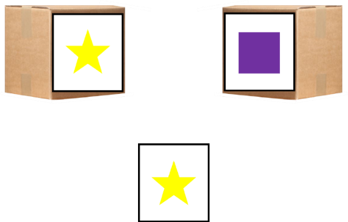
At the laboratory visit, children played fun games that tested their executive function skills like attention, self-control, and regulation. Here is an example of a game that tested their working memory. Children were asked to remember the rule (e.g., sort cards by shape) throughout the game. They were shown the target at the bottom of the screen (i.e., star), and asked which was the correct box (i.e., star [left box] or square [right box]) to put the card into. Since the card showed a star, the box on the left is the target box!
There are lots of things you and your child can do together that will give your child more practice using his or her executive functioning.
- You can help your child to learn how to follow rules and inhibit impulses. Rules are important in everyday life. But, rules can be hard for young toddlers to follow! It will be easier for your two- year- old if you help them to understand exactly what is expected. For example, rather than saying “Don’t break the vase.” You can say, “Don’t touch the case.” You can also help link the rule to a goal. For example: “We cannot touch the vase because we don’t want to break it.”
- Giving clear alternatives may also help young children to manage their emotions and interests, and still follow your lead. For example: “We can look at the pretty vase and point at it, but we cannot touch it.” Repeating rules across contexts can also be helpful. Young children don’t have the same memory or perspective taking abilities as adults – just because they understand not to touch a vase today, doesn’t mean that they also understand not to touch a glass bowl tomorrow.
- Being consistent is also important. Consistency helps to reinforce the child’s memory and understanding of the rule. As children age, it can also be important to help share with them why the rule and goal are important: “Granny gave me this vase, so I would be sad if it broke. Let’s not touch the vase so we don’t break it.”
- Finally, it is important to remember that following the rules is really hard work for young children. It’s important to praise your child when he or she does a good job following the rules.
- You may also wish to let your child be in charge sometimes. This will give your child a much-needed break from all the hard work he or she is doing trying to follow the rules, and let him or her feel in control about some things. Allowing your child some control will also help him or her be more receptive to listening at other times. In fact, sometimes your child may even want to make up his or her own rules for playtime – this is great practice for understanding rules.
Imitation
Sometimes, you may notice that when you say something, your child repeats what you said, or that when they see you smile, they smile back. This is imitation and is a very important way that children learn.
At the laboratory visit, children took part in some “imitation tasks” that help us understand their imitative behaviour. The experimenter played with a toy in a certain way in front of your child. Next, your child was given the opportunity to play with the same toys. We video-recorded the way your child played with the toys to assess their imitative learning.
You can learn more about your child’s imitative behaviour at home by using simple steps to show your child how to use new toys and objects. Toddlers are likely to be able to pay attention to what you model to them, but it may take time for them to accurately reproduce all of the actions. Providing opportunities to model different actions and good behaviour will be beneficial for your child as he or she continues to learn more and more things! It will also help you to understand what types of things are most interesting and engaging for your child, and to practice giving clear instructions that help him or her learn. Don’t be surprised if, as your child gets older, he or she may start asking you not just how to do something, but also why you are doing it, and he or she may even start to experiment with new ways of accomplishing goals!
Theory of Mind
When we think about young children’s learning, we often think about things like numeracy, literacy, and language skills that may benefit them in the future. However, did you know that young children are also able to learn what other people think, and such ability might be important for their cognitive and social development as well? Theory of mind (TOM) is the word researchers use to describe the understanding of what others might be thinking or feeling.
At the laboratory visit, your child took part in a TOM task that helps us understand how young children start to understand that other’s desires might be different from their own.
At around 2 years of age, children start to show awareness of the difference between thoughts in people’s minds and things in the world. However, at this age, even if young children know that their preferences are not the same as someone else’s, they may still choose their own preferred item when asked about someone else’s choice. Talking about what others think or reading storybooks that involve emotions and mental states may help kids develop TOM. As young children develop stronger TOM abilities, they will be able to understand you better and maybe even start offering you foods that you like to eat, instead of giving you the special treat of his or her own favourite snacks!
Mastery Motivation
You may remember a part of the parent-child interaction segment when your child was asked to play with an increasingly challenging set of barn-themed shape sorters while you were asked not to touch the toys. Some of these shape sorters were intentionally designed to be very difficult for your child, so your child was not necessarily expected to be able to put all animals into the barn. What we are interested in is your child’s Mastery Motivation – or how much interest, effort, and joy he or she shows during the experience. Mastery motivation is often a predictor of subsequent effort, interest, and achievement.
You can help your child to persist during challenging tasks by offering encouragement. In some cases, this may mean taking an interest in what he or she is doing and complimenting his or her effort. In other cases, you may want to ask questions to challenge their thinking and make them curious. At this age, most children still find it difficult to understand or answer complex questions, but you can use questions like “what animal is that?” to direct their attention, or “should we try again?” to help them persist on the task.
Reaction Time

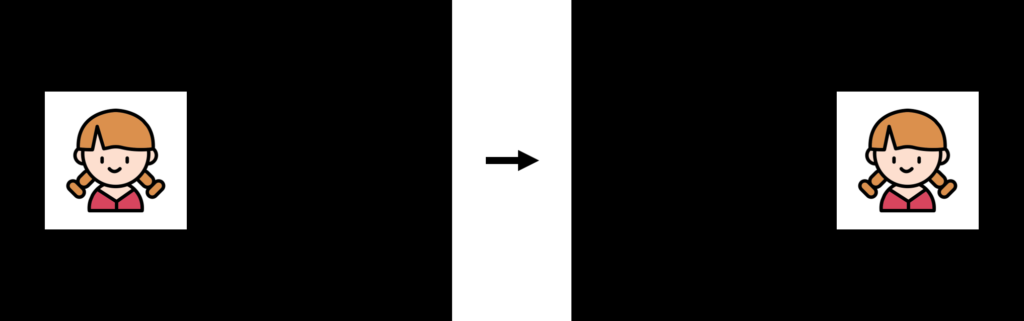
Children completed a reaction time task that involved their looking at one picture (i.e., left – bullseye) and then shifting their gaze to the next picture (i.e., right – star).
The green and pink/red dots you see on the screen represent the left/right eye gaze locations that are captured by the eye-tracking equipment used in the study.
As children get older, they may be able to achieve greater progress in a task because they find the task more interesting or simply can sit still for a longer period. Their reaction time is also likely to become faster. However, children’s task progress may also wane with age if they find the task less interesting, and their reaction time may slow if they spend more time thinking about the task. There is so much to learn about how children learn! Your children’s participation has been invaluable in carving out new understanding about this topic.
Relational Memory
“Who else has a rattle like that?” “When did I last change your diaper?” “Where did we put your soft toy?”
When you answer questions like this, you are using Relational or Associative Memory. Relational memory is important to remembering associations between more than one thing, person, place, or time. We use relational memory to shape the stories of our lives, to remember the ways rules and ideas fit together, and even to create our expectations about the future. It’s unclear exactly when relational memory begins to come online, but most people agree that memory changes quite a bit during early development. In fact, by age 11, some forms of relational memory still have not reached adult levels!
Babies’ memories can be much more fragile than those of older children and adults. For example, a 6-month-old who has learned to play with a toy in his or her bedroom may not remember how to play with the same toy in a different room. As babies age, this changes and is not something to worry about. In the meantime, you can share the enjoyment that comes with learning new things and continue to support memory development with good nutrition and adequate sleep.
In BE POSITIVE, we are interested in understanding: (1) how different forms of relational memory develop, and (2) the ways in which emotion influences memory. We used a long-standing tenet in learning and memory research that many studies have reported: individuals tend to look more closely and for a longer time at things (stimuli) that are new and interesting.
One form of relational memory we study is item-space memory. Item-space memory, as its name describes, refers to the associations between an item and a location (space).
For example, the BE POSITIVE children were shown pictures of happy and angry children in different locations. Children’s eye-tracking activity was captured using our eye-tracking equipment. Children may look longer at an image (item) that has changed locations because this is new to them. This is one way of demonstrating item-space memory: by looking longer, they may be showing that they remember that the item’s original position is different.
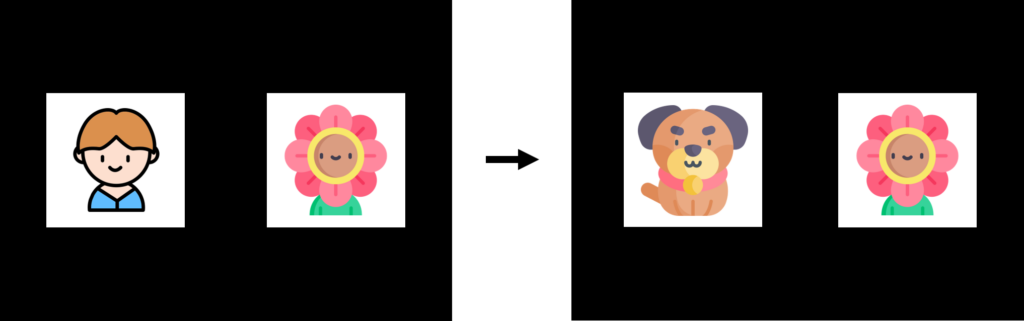
During this relational memory task, the BE POSITIVE children were shown pictures of children and flowers to test their item-item memory. In the learning phase, they were shown a pair of face – flower stimuli so they could learn and remember the pairing. In the testing phase, they were presented with either the same pairing or a different pairing. Children’s relational memory for the item-item format was assessed by whether they spent more time looking at the new (different) pairing than what was presented during the testing phase.
In your time with your child, you may have noticed that your child can now remember a lot more than when he or she was a baby. Still, you may find that even though it seems like he or she can show off something he or she has learned at home, he or she may not always be able to do it at another place (e.g., grandparents’ home). There are a few reasons for this, and one of them has to do with memory.
Big differences in the context in which something is first learned, and the context in which they attempt to demonstrate their newly learned skill may make it more difficult to remember the new skill. In fact, this may help to explain why it is easier for young children to learn new things when they are shown live demonstrations or when they are actively involved than when shown things on a screen. For some children, it may be helpful to label (i.e., put names) new objects and ideas, and for others, it may be more helpful to discuss minute details. In any case, continue to applaud their efforts as they try to learn new things! Remembering things across contexts is hard!
You must be logged in to post a comment.