BE POSITIVE stands for Beginning Early: SingaPore’s Ongoing Study starting in Infancy of Twenty-first-century-skills, Individual differences, and Variance in the Environment (BE POSITIVE study). BE POSITIVE is one of the flagship projects of the Centre for Research in Child Development at the National Institute of Education, Nanyang Technological University in Singapore.
Broadly, the BE POSITIVE study seeks to examine the development of children’s domain-general skills from infancy to toddlerhood and their impact on later achievement.
As a longitudinal study, participants completed multiple visits across 8 possible time points. This allows us to craft an understanding of developmental trajectories and identify individual differences.
Because study recruitment was conducted across 3 phases, and participants may have entered the study at different phases, this cross-sequential design allows us to examine development over time that is not marred by cohort effects (i.e., effects that may impact all participants who joined at the same time).
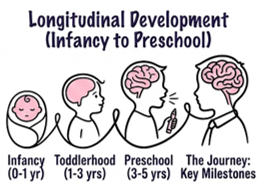
A knock-on effect on development across the life span
Research has consistently reported predictive links between domain-general skills and later academic success and achievement. These may then set the stage for individuals’ professional success in the workplace and feed into overall well-being and life satiety.
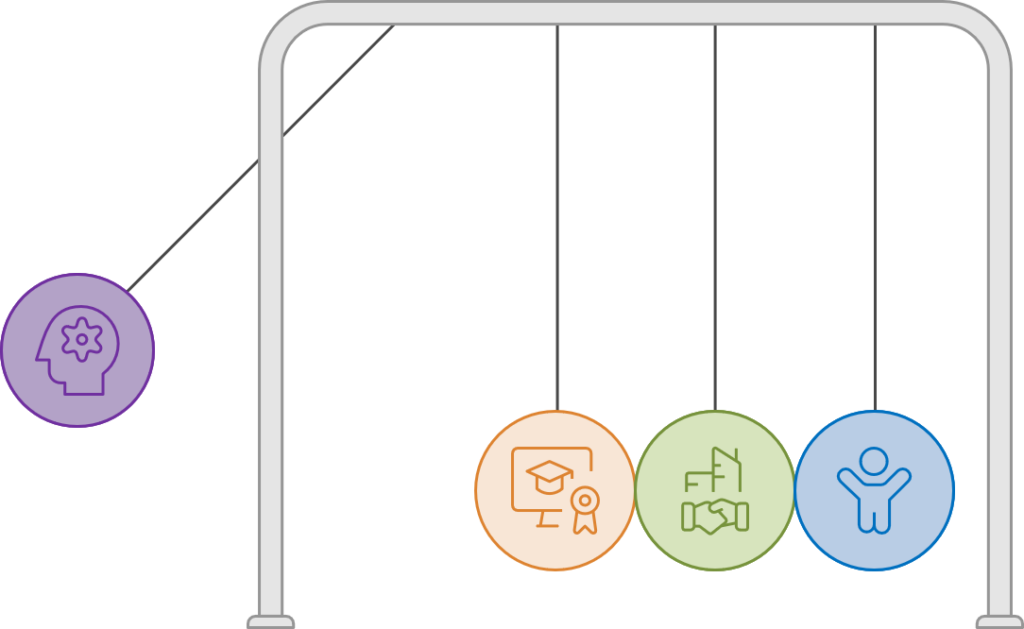
More information on types of skills important for life course development
Domain-general skills include memory, cognitive flexibility, emotion regulation, and problem-solving. These skills are thought to be building blocks that fundamentally underlie later achievement (i.e., domain-specific skills), they are pre-cursors to the ever important Twenty-first Century Skills that are typically associated with adult wellbeing and success.
What data did we collect?
BE POSITIVE study children completed various tasks that allowed us to assess their development across various domains. For a comprehensive list of tasks completed during the visit, please see here.
Children completed some tasks with eye-tracking equipment, allowing for a multi-disciplinary investigation on children’s development.
Apart from children’s normative development as part of their growth, BE POSITIVE also collected information on children’s environmental influences. For example, parents returned structural and quantitive information on the caregivers in children’s lives, where children spent their time (e.g., at school, at enrichment classes, at home), and qualitative information on caregivers’ mental health, caregiving practices, and sociodemographic statuses.
You must be logged in to post a comment.